
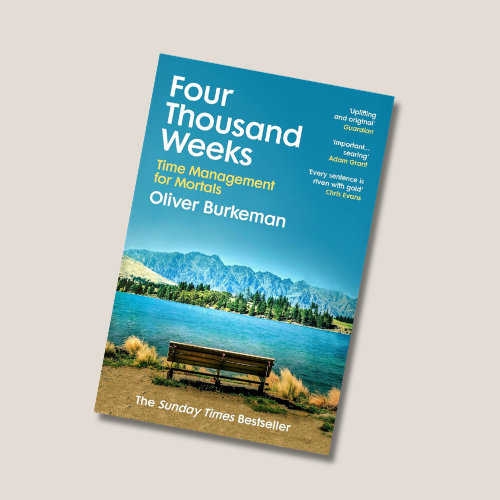
4000 Weeks by Oliver Burkeman is not your average self-help book. He calls it “Time Management for Mortals” but I think of it more as an anti-productivity book. For a productivity nerd like me, this is just what I needed.
It’s not a complete anti-productivity book, but more of a protest against the hustle culture that exists, and the pressure we put on ourselves to do more.
I admit, it took me a while to figure out how I felt about 4000 Weeks, mostly because I had to reconcile my prevailing approach of “dream big, reach for the sky” with Burkeman’s reality check that we are, in fact, finite — that we can’t do everything that we want to, no matter how hard we try.
Here are 4 lessons from 4000 Weeks by Oliver Burkeman
#1 “The day will never arrive when you finally have everything under control.”
For my entire adult life, I have felt that my to-do list never, ever ends. EVER.
Worse, it keeps getting longer.
Lists everywhere. Lists on Keep, lists in Trello, lists in this notebook and that, lists on random pieces of paper, and lists within lists.
I keep thinking I’ll eventually get to this, or that, and I often lament that there is never enough time.
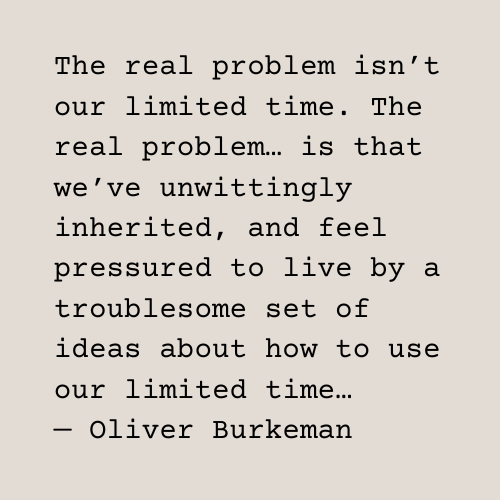
Oliver Burkeman wrote, “The real problem isn’t our limited time. The real problem… is that we’ve unwittingly inherited, and feel pressured to live by a troublesome set of ideas about how to use our limited time…”
There will always be more to do.
We simply have too much to do — whether it be things we need to do or want to do, and it will probably always be that way.
To let go of things that matter less, Burkeman says we should “develop a taste for problems” and that we don’t have to deal with every problem. Problems will always exist — it is the nature of life — our lives will never be problem free. “The presence of problems in your life… isn’t an impediment to a meaningful existence, but the very substance of one” (Burkeman 2021).
So, YES, we should fix problems, we should make the world a better place, we should make our lives better, but we don’t have to fix every problem and we don’t have to tick off every item on our to-do list.
Burkeman states that we should acknowledge and accept our finite lives, so we can focus on the few things that matter most, at this moment in your life — we need to choose what matters most and where our finite time will go, “because now is all you ever get” (Burkeman 2021).
This reminds me of a quote by Edward Everett Hale, “I am only one, but I am one. I cannot do everything, but I can do something. And because I cannot do everything, I will not refuse to do the something I can do.”

#2 Procrastination is essential
I used to think that procrastination was a weakness, a challenge to overcome. And yes, it is that at times, but Oliver Burkeman points out that procrastination is actually essential.
To choose one thing is to procrastinate everything else.
“Procrastination of some kind is inevitable… at any given moment, you’ll be procrastinating on almost everything… So the point isn’t to eradicate procrastination, but to choose more wisely what you’re going to procrastinate on, in order to focus on what matters most. The real measure of any time management technique is whether or not it helps you neglect the right things.”
Despite what productivity experts tell us, it’s not possible to do everything. To do the things we truly value, we need to put aside the rest, rather than spreading ourselves thin.

#3 We often hold ourselves to standards that we shouldn’t be expected to meet
I spent my younger years surrounding myself with affirmations and quotes such as:
- Dream, believe, create, succeed
- Don’t quit
- Shoot for the moon and even if you miss, you’ll land amongst the stars
- “Some men see things as they are and ask why. Others dream of things that never were and ask why not.” — George Bernard Shaw
- “All our dreams can come true, if we have the courage to pursue them.” — Walt Disney
- “The heights by great men reached and kept were not attained by sudden flight, but they while their companions slept, were toiling upward in the night.” — Henry Wadsworth Longfellow
Dreaming big is vital, but we need balance. Burkeman points out that we overvalue our existence — we are “a miniscule little flicker of near-nothingness in the scheme of things”.
The problem with overvaluing our existence is that it gives rise to an “unrealistic definition of what it would mean to use your finite time well. It sets the bar much too high. It suggests that in order to count as having been well spent, your life needs to involve deeply impressive accomplishments, or that it should have a lasting impact on future generations” — that we can’t just be ordinary. That’s not to say we don’t matter, but Burkeman says it is “implausible for us to demand we become Mozart or Einstein”.
We should refuse to hold our time to an “abstract and overdemanding standard of remarkableness”.
This is so conflicting, for me and perhaps for you too. I’m definitely no Mozart, but perhaps you could be. So how do we reconcile our drive to dream big with our finite lives?
Burkeman writes that when we put less pressure on ourselves to be the next Mozart or Einstein, we can focus on the next best step of what is truly important to us, rather than being overwhelmed with the idea of who we should be — a bit like Alysa Liu and her decision to skate on her own terms.

#4 We must limit our “caring”
For all the doom scrollers out there, this one’s for you.
In his book, Four Thousand Weeks, Oliver Burkeman says that we must consolidate our caring.
We need to decide what we care about — if we care about everything, it makes it difficult, if not impossible, to care about what we value most.
Social media, for example, does an awfully good job at getting us to care about things we don’t actually care about. It gets us to “care about too many things, even if they’re each indisputably worthwhile. We’re exposed… to an unending stream of atrocities and injustice” and each may be worthy but together, “are more than any one human could ever effectively address”.
Social media “is designed to prioritise whatever’s most compelling — instead of whatever’s most true, or most useful — it systematically distorts the picture of the world we carry in our heads at all times. It influences our sense of what matters, what kinds of threats we face, how venal our political opponents are, and thousands of other things — and all these distorted judgements then influence how we allocate our offline time as well.” Social media doesn’t just influence us while we’re using it, it influences us all the time, when we’re offline and going about our lives.
Devices don’t just distract us from what is important, “they change how we’re defining ‘important matters’ in the first place”.

Why does this matter? Social media is not a neutral space. The creators of these platforms design social media to be deeply addictive, to encourage compulsive behaviour through pervasive design, just like casino slot machines. Burkeman points out that social media platforms are designed to keep us coming back — every time you drag down to refresh your feed, it’s a form of variable reward — we can’t predict what will happen when we refresh the screen, and this “uncertainty makes you more likely to keep trying, again and again, just as you would a slot machine.”
Attention… is life: your experience of being alive consists of nothing other than the sum of everything to which you pay attention…. So when you pay attention to something you don’t especially value, it’s not an exaggeration to say that you’re paying with your life. — Oliver Burkeman
Burkeman says we should focus our “finite capacity for care” and to consciously pick our battles in charity, activism and politics. If we care about everything, it’s hard to make a difference in the areas we care about the most.
Read 4000 Weeks by Oliver Burkeman
Many of us will have 4000 weeks in our life, if we’re lucky.
Take some time in your 4000 weeks to read or listen to Four Thousand Weeks by Oliver Burkeman, and let me know your key takeaways below.
Image: Alysa Liu by YantsImages available at Wikimedia Commons under a Creative Commons Attribution-share Alike 4.0 International licence. Full terms at Creative Commons 4.0.
Further reading: My Five Favourite Books About Having a Growth MIndset
0 Comments